
Key Takeaways
- The Symptom on the Line
- Practical guidance for PCB handling and line automation.
- Specifications below are taken from real Keli equipment.
A conveyor height mismatch rarely stops an SMT line at once. It shows up as small transfer faults, extra operator attention, and repeated adjustments at station interfaces. Over time, those small faults affect PCB handling, signal handover, and line balance. This article looks at why conveyor height consistency matters, what causes it to drift, and where a defined dual-track link conveyor fits in a practical line layout.
The Symptom on the Line
The first sign is usually at the handover point. A board leaves one station cleanly, then hesitates at the next conveyor. It may touch the rail edge, enter at a slight angle, or trigger an incoming signal later than expected. Operators often respond by nudging a conveyor, adjusting a guide, or restarting the transfer.
In a single-lane SMT line, this is disruptive. In parallel production stations, the effect is multiplied. One lane may continue to run while the other needs attention. The result is uneven board flow, even when both machines are ready to run.
Height problems are easy to misread. A delayed sensor signal can look like a control issue. A skewed board can look like a belt issue. A repeated jam can look like a PCB design issue. In many cases, the root cause is mechanical alignment across the line.
For board handling equipment, the transfer plane is part of the process. If the plane changes between stations, the PCB handling system has to absorb the difference. That adds variation at the exact point where repeatable transfer is needed most.
Root Causes of Height Variation
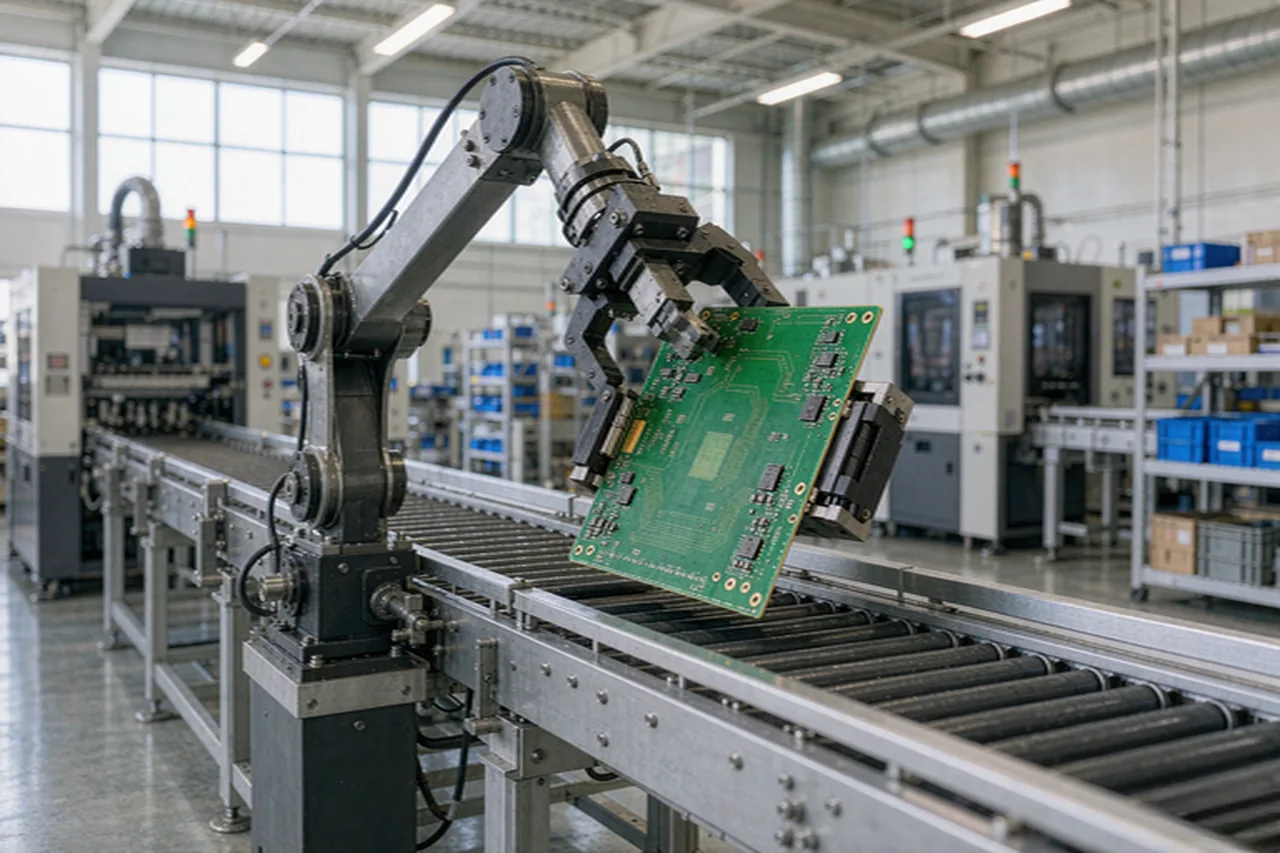
Conveyor height inconsistency usually comes from the line build, not from one dramatic failure.
Mixed equipment is a common cause. SMT lines often combine machines from different stages of investment. Each station may have its own frame, rail design, and working height. Even when the nominal height appears aligned, the actual transfer surface can differ once belts, rails, and brackets are included.
Floor conditions also matter. A line that is leveled during installation can shift after maintenance, relocation, or nearby equipment changes. Adjustable feet are useful, but they can also introduce variation when several people make small corrections over time.
Rail construction is another factor. Dedicated aluminum profile rails on both sides give a defined reference for board transfer. When rail structures differ between stations, the conveyor may still move the board, but the support geometry changes. This is more visible with wider boards or dual-lane transfer.
Length also plays a role. A link conveyor that is too short leaves little room to manage the interface between stations. A link section with an adjustable rail length from 500 to 1500 mm gives the line builder a defined range for the connection. The KL-300DC uses this range and supports customizable rail length within the stated specification.
Finally, control handover can expose height errors. Incoming and outgoing board signals depend on predictable board arrival. Four sensors, one at each end of both tracks, help define where the board is detected. If the board enters unevenly, the handover becomes less repeatable.
Why the Cost Is Higher Than It Looks
A small height mismatch is often treated as a minor setup issue. The cost is broader than the immediate stop.
First, it consumes engineering time. Process engineers check sensors, I/O timing, belt condition, and machine programs. Maintenance teams check leveling and rail alignment. Purchasers may be asked to source brackets or replacement parts. The investigation takes longer when the symptom moves between mechanical and control domains.
Second, it reduces usable line balance. In high-throughput PCB assembly, each transfer point should support steady flow. If one lane needs more attention, the parallel process loses part of its advantage. A dual-lane line can still produce, but not as a stable pair.
Third, it increases dependence on operator intervention. A line that needs frequent small corrections is harder to standardize across shifts. One operator may adjust the rail, another may adjust the sensor position, and another may reset the station. The setup becomes tribal knowledge instead of a documented line condition.
Fourth, it complicates future changes. When a new station is added, the existing height reference has to be checked again. If the line has no consistent conveyor height standard, each change creates another alignment task. This affects system integrators during commissioning and factory teams during later expansion.
The hidden cost is not only lost output. It is the loss of a clean mechanical reference across the SMT line.
A Practical Approach to Height Consistency
Start by treating conveyor height as a line specification, not a machine-by-machine setting. Define the transfer plane at each interface. Check it with the belts and rails installed, not only with the frame. Record the working height and the adjustment range used at each station.
Next, separate mechanical alignment from signal logic. Confirm that the board travels flat and square before troubleshooting I/O timing. Incoming and outgoing board signals are useful only when board arrival is consistent. Sensor placement should support a repeatable transfer point.
Then review the link sections between stations. These sections should match the line height, support the required board width, and provide a clear handover. For dual-lane transfer, both tracks need the same mechanical reference. A mismatch between lanes can create the same problem as a mismatch between machines.
The KL-300DC Dual-Track PCB Link Conveyor is built for this interface role. It transfers boards on two tracks at once between SMT stations. Its rail height is 900 ±30 mm, giving integrators a defined adjustment band when matching neighboring equipment. The steel frame uses dedicated aluminum rails on both sides. Each lane adjusts from 50 to 300 mm, supporting dual rail width setup within the stated range.
The conveyor uses 3 mm green flat belts and two 4248 motors, one per track. Four sensors detect boards at both ends of both tracks. Incoming and outgoing board I/O signals support handover with connected stations. Control is handled by an industrial control board. Transfer direction can be left-to-right or right-to-left.
These details matter when the goal is a stable transfer plane. The product does not remove the need for line-level height checks. It provides defined mechanical and control points for the link section, which is where many PCB handling issues appear.
Where the KL-300DC Fits in the Line
The KL-300DC fits applications that need dual-lane board transfer in SMT lines, connecting parallel production stations, high-throughput PCB assembly, and lines requiring I/O signal handover.
In a parallel line, the conveyor sits between stations as a defined link. Both tracks carry boards at the same time. Each track has its own 4248 motor. The dual rail width range of 50-300 mm supports lane adjustment within the specified limits. The rail length of 500-1500 mm, customizable, helps fit the physical gap between stations.
The 900 ±30 mm rail height is the key figure for height planning. It should be checked against the transfer plane of the upstream and downstream equipment during layout and commissioning. The ±30 mm range gives a defined adjustment band, but the final setting still needs to be matched across the full SMT line.
The four sensors, one at each end of both tracks, support board detection at the entry and exit points. Combined with incoming and outgoing board signals, they give the line control system clear handover points. This is useful when parallel stations need predictable board flow rather than manual release.
For system integrators, the KL-300DC provides a clear set of interface data: rail length, dual rail width, belt type, rail height, motors, sensors, I/O signals, control method, and transfer direction. For factory purchasers and equipment engineers, that makes the board handling equipment easier to specify against the rest of the line.
Build the Line Around a Stable Transfer Plane
Conveyor height consistency is not a cosmetic detail. It affects board travel, sensor detection, signal handover, and the amount of attention a line needs from operators and engineers. The practical fix is to define the transfer plane, verify it at each interface, and use link conveyors with clear mechanical and control specifications.
The KL-300DC Dual-Track PCB Link Conveyor gives SMT lines a defined dual-track link with stated rail height, rail length, lane width, belt, motor, sensor, and I/O data. It is a fit for parallel stations that need repeatable PCB handling and clean handover between processes.
Contact Keli with your line layout, station interface requirements, and PCB handling needs to discuss the KL-300DC for your SMT line.