
Key Takeaways
- The symptom on the line
- Practical guidance for PCB handling and line automation.
- Specifications below are taken from real Keli equipment.
A solder defect is often investigated at the printer, the paste, or the reflow profile. That is reasonable, but it can miss a simpler input: the condition of the board surface before SMT processing. Dust, fibers, and other particles can interfere with printing, placement, coating, and inspection. Static can make those particles harder to remove. For purchasers, process engineers, and system integrators, the practical question is where to place a controlled cleaning step in PCB handling, and how to keep it stable across different boards.
This article looks at the symptoms on the line, the common root causes, the real cost of late detection, and a practical board handling equipment solution using the PCB Single-Track Cleaning Machine.
The symptom on the line
Surface contamination rarely appears as one clear failure. It tends to show up as variation. A board prints cleanly, then the next board shows an inconsistent deposit. A placement process that was stable begins to need more attention. Inspection finds particles where they should not be. Coating preparation takes longer because the surface is not in the expected condition.
In an SMT line, these symptoms can be easy to assign to the wrong station. If printing looks inconsistent, the first response may be to check the stencil, solder paste, or setup. If placement is affected, attention may move to feeders or vision. Those checks are necessary. But they do not answer a basic question: did the board arrive at the process with a clean, static-controlled surface?
Board handling equipment sits between processes. That makes it part of the process condition, not just transport. If dust is carried into printing or placement, the downstream station receives a variable input. The result is more troubleshooting, more stops, and less confidence in the process window.
For lines running PCB assembly requiring static control, the issue has two parts. The first is the particle itself. The second is the charge that helps keep it on the surface. A cleaning step that only moves air across the board may not address both.
Root causes: particles, static, and handling conditions
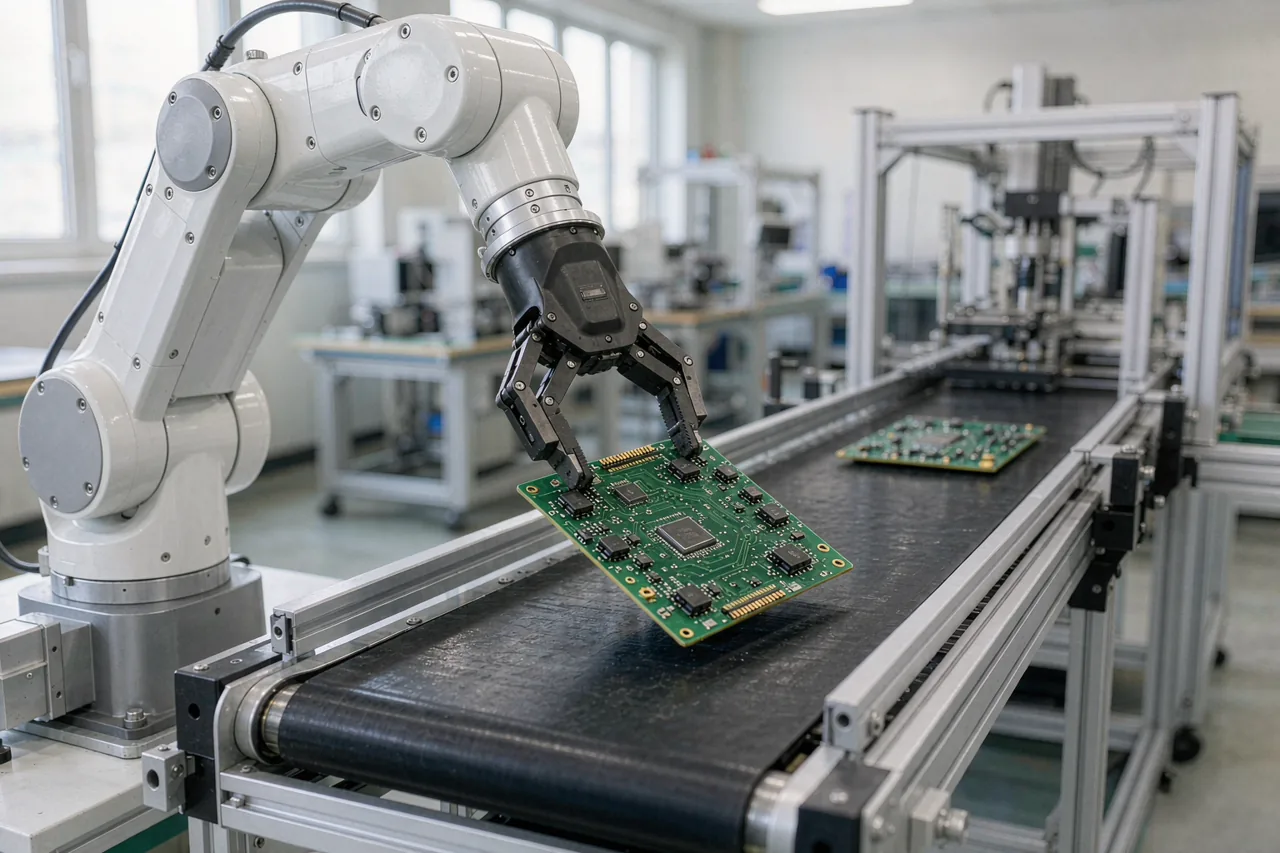
The FACT ANCHOR for the PCB Single-Track Cleaning Machine identifies the target clearly: it removes dust and particles from board surfaces before SMT processing. The machine uses two anti-static brushes and an ionizer to release static and lift dust, while a suction system with a silent high-pressure fan collects it. That combination points to the main root causes found in production environments.
First, boards can carry dust and particles before they enter the SMT line. This may come from upstream storage, unpacking, separation, or general handling. The article does not need to assume a single source. The point is that the contamination is already on the surface when the board reaches printing, placement, coating, or inspection.
Second, static makes removal less reliable. The ionizer automatically senses and releases positive and negative ions. This supports static control during cleaning instead of relying on brushing alone. For electronics production with high cleanliness requirements, that distinction matters. A particle that is lifted but not collected can return to the board or move to another area.
Third, cleaning settings need to match the board and contamination level. Brush speed and conveyor speed are adjustable. This is important because a fixed setting is not suitable for every production condition. A small board, a larger board, and a board with a different contamination level may need different handling. The machine provides a controlled range rather than a single fixed motion.
The PCB Single-Track Cleaning Machine uses anti-static brushes with a spiral design for effective cleaning. It also uses a digital variable-speed stepper brush motor with a brush speed of 200-1200 rpm. Conveyor speed is adjustable from 0 to 17.5 m/min, driven by a 15 W variable-speed motor. These are the operating parameters available to the engineer when setting up the cleaning step.
Why it costs more than it seems
The cost of poor board surface cleanliness is not limited to scrap. It often appears first as time. Operators stop the line, check the printer, review placement data, or repeat inspection. Engineers compare settings that were not the source of the variation. A process that should run with a stable input becomes a process that needs repeated interpretation.
There is also a hidden cost in delayed discovery. If contamination affects printing or placement, the defect may not be fully understood until inspection or later test. By then, more boards have passed through the same condition. The line has already used materials, machine time, and labor on those boards.
For factory purchasers, this affects equipment decisions. A low-cost handling gap can create a high-cost process problem. Board handling equipment should be reviewed as part of the full SMT line, not as an isolated conveyor accessory. The question is not only whether boards move from one station to the next. It is whether they arrive in the condition expected by the next process.
For system integrators, the cost is in line stability and handover. A cleaning module with clear control and adjustable parameters is easier to fit into a defined process flow. The PCB Single-Track Cleaning Machine uses PLC control with a touchscreen. Transfer direction is left-to-right / right-to-left. These features support integration planning without requiring a custom control concept for basic operation.
The machine dimensions are 600 x 1040 x 1200 mm. That matters during layout review, especially where an existing SMT line has limited space between printing and placement, or before coating or inspection. The board size range is 50 x 50 mm to 460 x 460 mm. That defines where the unit can be applied in PCB handling and where another solution may be required.
A practical solution: clean before the critical step
The most practical approach is to place cleaning before the process that depends on surface condition. The stated applications are dust removal before SMT printing and placement, cleaning before coating or inspection, PCB assembly requiring static control, and electronics production with high cleanliness requirements. In each case, the cleaner is positioned upstream of the step that needs a controlled surface.
The PCB Single-Track Cleaning Machine is designed for single-track cleaning for PCB surfaces before assembly. Its cleaning method follows a clear sequence. Two anti-static brushes with a spiral design lift dust. The ionizer automatically senses and releases positive and negative ions to address static. The suction system with a silent high-pressure fan removes dust. Brush speed and conveyor speed are adjustable to match the board and contamination level.
This is useful because the engineer can define the cleaning setup as part of the process recipe. Brush speed can be set within 200-1200 rpm. Conveyor speed can be set from 0 to 17.5 m/min. The conveyor uses a 15 W variable-speed motor. Control is handled through PLC + touchscreen. These are not abstract features; they are the parameters used during commissioning and production setup.
The unit supports bidirectional transfer: left-to-right / right-to-left. That gives integrators flexibility when matching the SMT line direction. The board size range of 50 x 50 mm to 460 x 460 mm covers the stated application window. The machine dimensions of 600 x 1040 x 1200 mm give a defined footprint for layout checks.
This is not a claim that cleaning solves every solder defect. Stencil condition, paste, placement accuracy, reflow setup, and board design still require control. The narrower point is more useful: if dust and static are not controlled before printing or placement, the line is being asked to process a variable surface. Removing that variable makes downstream troubleshooting more direct.
Where the product fits in PCB handling
In a typical SMT line, the cleaner belongs at the point where boards are still bare or prepared for the next operation. It is board handling equipment with a process function. It does not replace the printer, placement machine, coater, or inspection system. It improves the condition of the board entering them.
Use it for dust removal before SMT printing and placement when surface particles are part of the defect pattern. Use it before coating or inspection when the surface condition affects the next step. Use it in PCB assembly requiring static control where the ionizer and anti-static brushes are relevant to the handling requirement. Use it in electronics production with high cleanliness requirements where a defined cleaning stage is needed before assembly.
The setup should be reviewed in practical terms. Confirm the board size against the 50 x 50 mm to 460 x 460 mm range. Confirm the transfer direction against the line layout. Review the 600 x 1040 x 1200 mm footprint during integration. Set brush speed and conveyor speed according to the board and contamination level. Keep the PLC + touchscreen settings aligned with the line’s operating method.
For purchasers, this gives a clear specification checklist. For equipment engineers, it gives adjustable process parameters. For system integrators, it gives defined dimensions, direction, control, and board range. The benefit is not a vague promise of better production. It is a controlled cleaning step that can be placed, set, and reviewed like other equipment in the SMT line.
Board surface cleanliness affects solder quality because it affects the condition of the board before solder paste is printed and components are placed. When dust, particles, and static are left uncontrolled, the line receives a variable input. When they are addressed before the critical step, the process has a cleaner starting point and fewer unrelated variables to investigate.
Contact Keli with your board size range, line direction, and cleaning requirements to review where the PCB Single-Track Cleaning Machine fits in your SMT line.