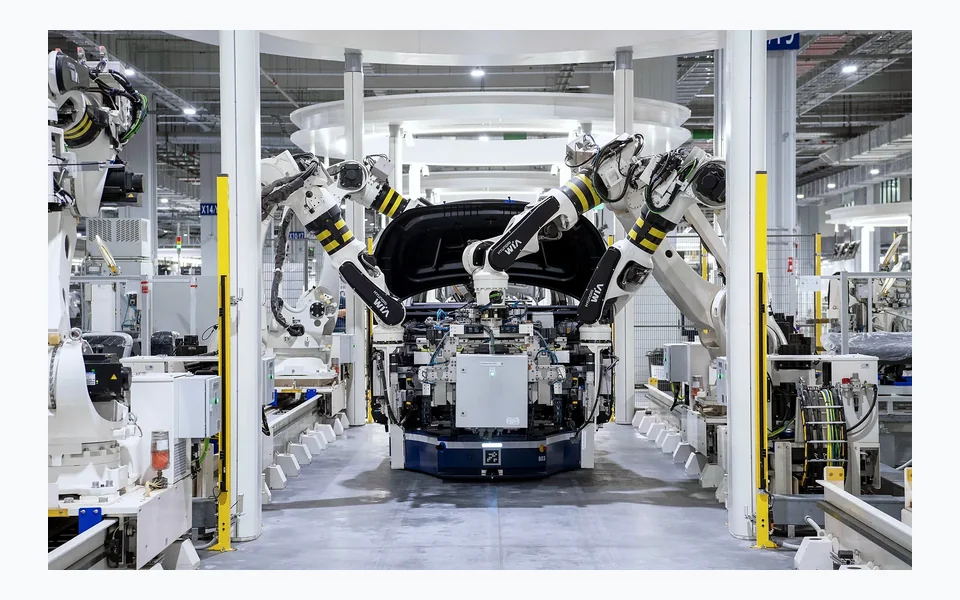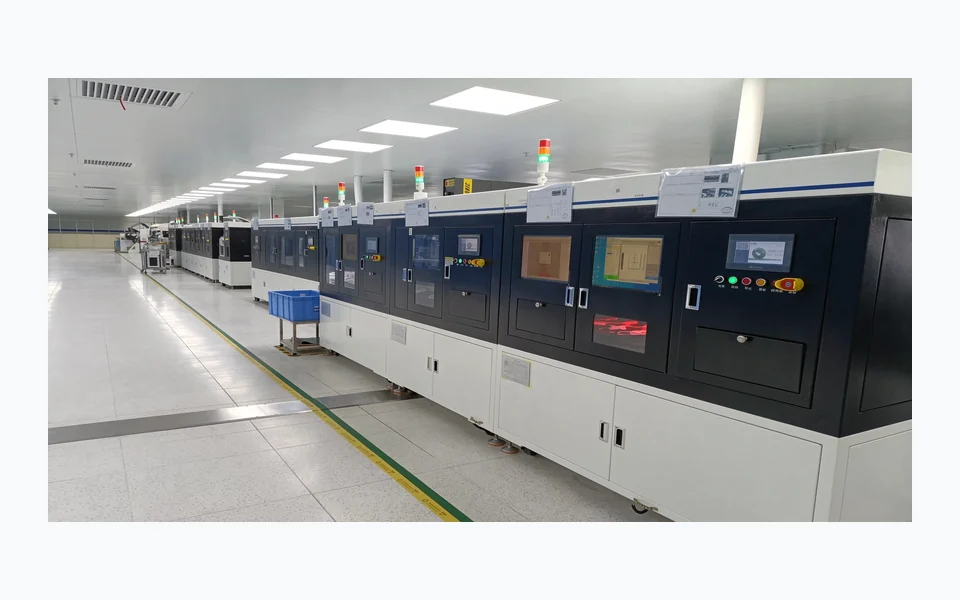
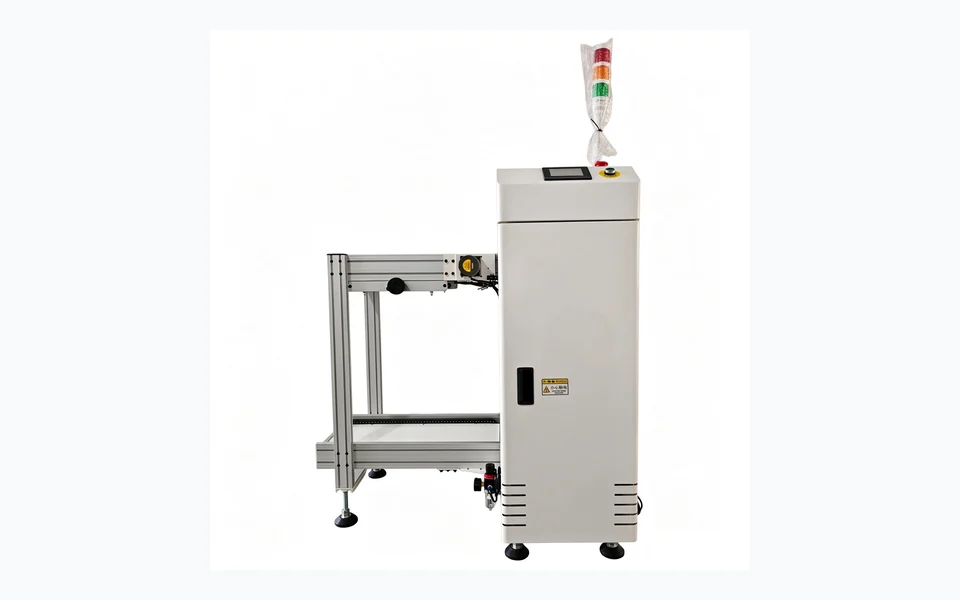
On a busy SMT floor, the equipment between inspection and packing matters as much as the placement machine itself. The KL-330NU OK/NG PCB Unloader is built for that in-between work: it takes boards from an AOI station and separates pass from fail without a person touching each board.
Key Takeaways
- Sorts AOI pass and fail boards into separate magazines.
- Handles boards up to 460 x 330 mm with left-to-right transfer.
- Includes a 0.8 m pusher conveyor for upstream handoff.
- PLC and touchscreen control make format changes straightforward.
1. What the KL-330NU Does
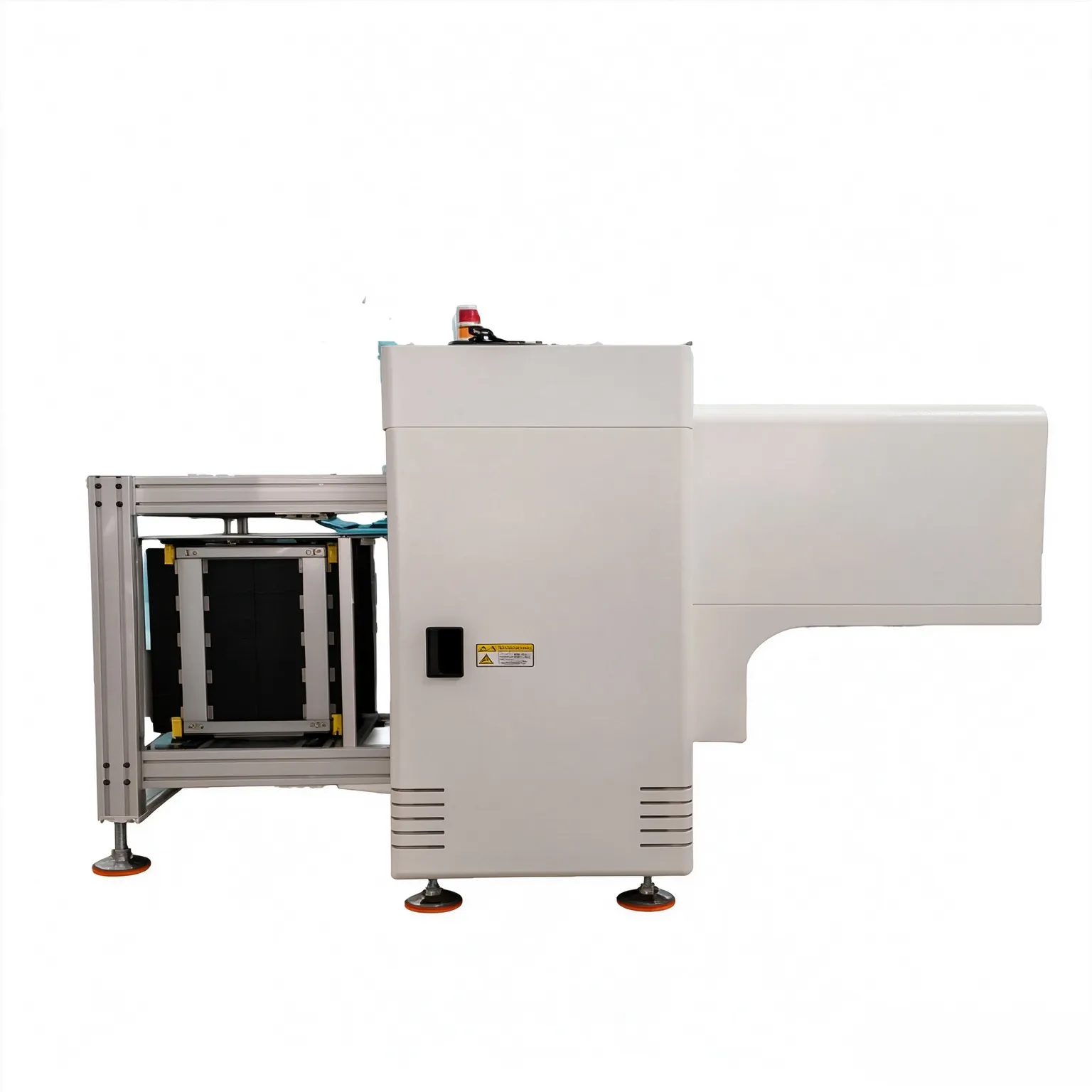
The unloader receives boards after inspection and places good and failed units into different magazines. That single step removes manual sorting, which is slow and easy to get wrong. A ball screw lift indexes each magazine, while a guided rail and sensor setup locates every board before transfer.
2. Design and Operation
Boards enter on guided rails, are located by sensors, and advance step by step. A PLC coordinates the sequence and the operator sets the board format on a touchscreen. Because the motion is fixed, every board follows the same path, which is what makes repeatable sorting possible. Pneumatic clamping holds the magazine in position during indexing.
3. Key Features
A few design choices make this practical on a production line:
- Lift pitch selectable at 10, 20, 30, 40 or 50 mm
- Pneumatic clamping structure
- Dedicated aluminum profile rails and special plastic chains
- Includes a 0.8 m transfer pusher conveyor
- 90 W motor with ball screw for magazine lift
4. Technical Specifications
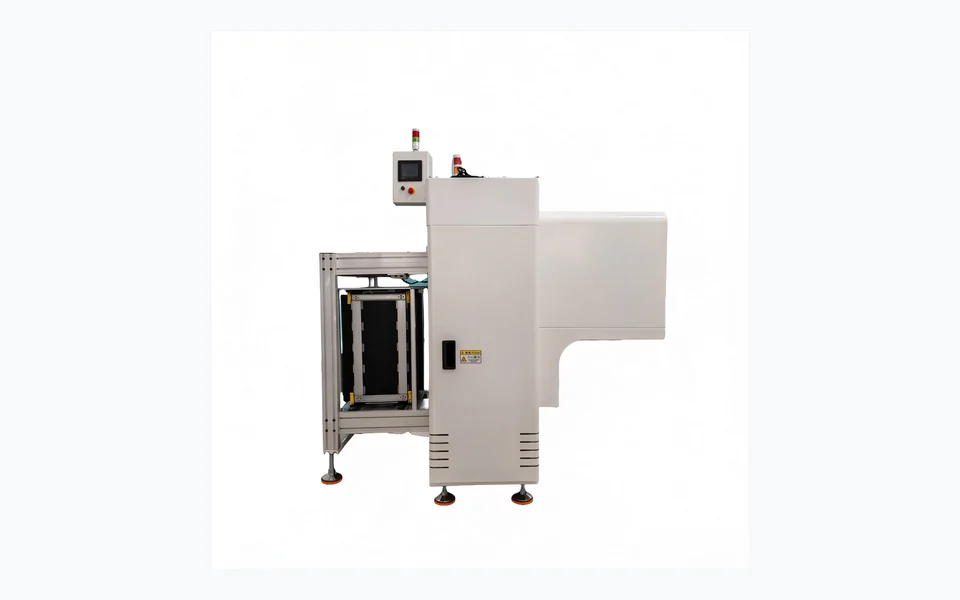
The key figures for line planning are:
| Item | Specification |
|---|---|
| Board size | Up to 460 x 330 mm |
| Magazine size | 460 x 400 x 565 mm |
| Transfer direction | Left-to-right |
| Power supply | Single-phase 220 V, 50 Hz |
| Pusher conveyor length | 0.8 m |
| Lift pitch | 10 / 20 / 30 / 40 / 50 mm |
| Lift drive | 90 W motor with ball screw |
5. Typical Applications
The equipment fits lines that need reliable separation after inspection:
- OK/NG sorting after AOI in SMT lines
- Lines handling boards up to 460 x 330 mm
- Defect isolation in PCB assembly
- Electronics manufacturing with in-line inspection stations
6. Why It Matters
Board flow is a system property. Improving one transfer point helps, but the full benefit appears when adjacent steps are planned together, so boards keep moving rather than queueing in a different place. Clean separation also makes the rework path predictable: failed boards go to a defined location instead of being mixed back into good output.
Summary
The KL-330NU gives an SMT line a controlled, repeatable way to sort boards by inspection result. We adapt the signal interface and magazine size to your process, and every unloader is tested for sorting accuracy before shipment. Share your board dimensions and line constraints, and our team will confirm the fit. Talk to our engineers →
Related reading
How to Select an Automatic PCB Loader
Read more →Designing an NG/OK Sorting Station
Read more →